2026 Practical Midrange Value
The 12 Best Aquarium Filters in 2026
Explore verified specs and architectural reviews of the best aquarium canister filters to balance biological capacity, flow, and long-term durability.
Main verdict: Selecting the best aquarium canister filters requires balancing motor power, mechanical bypass prevention, and operational wattage. For high-capacity filtration, the Fluval FX4 delivers an unmatched 700 GPH flow rate with automatic air-purging electronics. Value-focused aquarists managing tanks under 100 gallons will find the Sicce Whale 500 and Eheim Pro 4+ 600 offer superior biological volume and quiet, low-wattage operation.
Browse Aquarium Filters Categories
Quick Highlights
- Motor wattage dictates operating costs, with efficient units drawing 14W to 16W versus heavy-duty pumps consuming 30W to 32W.
- Real-world flow rates drop 30 to 50 percent once filter baskets are packed with dense mechanical pads and biological media.
- Built-in thermal integration, such as Oase Thermo units, eliminates in-tank equipment clutter but increases baseline electrical consumption to 22W.
- Bypass-free tray seating preserves biological colonies far more effectively than oversized empty canister volume.
Featured Shortlist
Aquarium Filters: Detailed Model Notes
Fluval FX4 High Performance Canister Aquarium
The Fluval FX4 outputs 700 GPH driven by a 30W microchip-controlled motor. The Smart Pump circuit pauses every 12 hours to vent trapped gas and maintain impeller torque. Its multi-stage stacked basket design handles large waste loads across aquariums up to 250 gallons.
Published specs
Ideal for: Large freshwater community tanks, predator setups, and messy cichlid aquariums up to 250 gallons. · Skip if: You need compact under-cabinet storage or run a delicate planted nano tank requiring gentle flow.
Strengths: Massive 700 GPH circulation for high-bioload habitats; Automated electronic purging prevents air locks; Utility drain valve simplifies water changes.
Drawbacks: Substantial physical footprint requires wide cabinet clearance; Higher power draw at 30W compared to European midrange canisters.
 9.5/10
Fluval FX6 High Performance Canister
The Eheim Pro 4+ 600 circulates 330 GPH while consuming only 16W of electricity. It features an integrated Xtender control dial that reroutes water around clogged fine pads during emergencies. High-precision German bearings keep acoustics nearly silent in quiet rooms.
Published specs
Ideal for: Medium to large planted aquariums up to 160 gallons where silent operation and energy savings matter. · Skip if: You maintain massive river setups needing turbulent surface agitation above 500 GPH.
Strengths: Ultra-low 16W energy consumption minimizes annual utility cost; Xtender emergency flow dial extends biological survival between cleanings; Square canister shape maximizes media capacity per footprint.
Drawbacks: Plastic latch handles require careful handling during basket extraction; Primer button can become stiff if biological debris accumulates.
 9.5/10
OASE BioMaster 2 850 Canister
The Oase BioMaster Thermo 600 integrates an internal heater directly into the canister body, removing unsightly glass tubes from display tanks. Its standout EasyClean pre-filter cartridge slides out independently without uncoupling the main canister head. The 22W motor drives 330 GPH through extensive biological trays.
Published specs
Ideal for: Aquascapers and refined display setups up to 160 gallons seeking minimal hardware inside the tank. · Skip if: You already own standalone digital titanium heaters or run coldwater species.
Strengths: Internal heating element keeps display tanks clutter-free; Modular pre-filter removes for servicing in seconds; Robust locking clamps with integrated shutoff valves.
Drawbacks: Higher initial hardware cost than standard unheated canisters; Pre-filter sponges require frequent rinsing to sustain peak GPH.
 9.5/10
Fluval 407 Performance Canister
The Penn Plax Cascade 1500 delivers 350 GPH through five distinct media baskets. Powered by a 32W motor, it accommodates massive biological media volumes for aquariums up to 200 gallons. Independent valve taps rotate 360 degrees to accommodate tight cabinet hose routing.
Published specs
Ideal for: Cost-conscious hobbyists seeking maximum media volume for large freshwater communities. · Skip if: You require dead-silent operation in a bedroom or home theater installation.
Strengths: Five deep media baskets provide unmatched customization for the price; Sturdy base prevents accidental tipping during maintenance; 360-degree rotating valve taps simplify hose installation.
Drawbacks: Higher energy consumption at 32W continuous draw; Motor head produces noticeable operational hum compared to Italian alternatives.
 8.4/10
Marineland Bio-Wheel Penguin 450 GPH Power
The Marineland Magniflow 360 processes 360 GPH using a dependable 26W motor assembly. Its lid gasket creates a positive mechanical seal against bypass leaks. The quick-disconnect valve block shuts off water flow instantly for dry cabinet maintenance.
Published specs
Ideal for: General community aquariums up to 100 gallons needing dependable multi-stage mechanical and chemical filtration. · Skip if: You prioritize low wattage and whisper-quiet acoustic engineering.
Strengths: Tool-free valve disconnect stops line leaks during filter disconnections; Stacking trays provide clean compartmentalization of chemical resins; Rugged latches form an airtight lid seal.
Drawbacks: Motor impeller requires periodic manual lubrication to avoid rattling; Rigid intake and outlet plastic components feel brittle under stress.
 8.7/10
SeaChem – Large Aquarium
The Sicce Whale 350 delivers 290 GPH while drawing an exceptionally frugal 14W. Engineered in Italy, its synchronized magnetic rotor ensures whisper-level sound output. Floating media baskets and polished internal walls streamline maintenance cycles in tight spaces.
Published specs
Ideal for: Office desks, bedrooms, and quiet living spaces housing aquariums between 40 and 90 gallons. · Skip if: You need heavy turnover for high-waste species or large tanks over 100 gallons.
Strengths: Industry-leading 14W power draw cuts ongoing operational expenses; Acoustic dampening creates near-silent motor performance; Floating basket design speeds up biological rinse routines.
Drawbacks: Limited to aquariums up to 90 gallons; Tubing diameter requires adapters for third-party glass lily pipes.
 7.8/10
OASE BioMaster 2 350 Canister
The Penn Plax Cascade 1000 provides 265 GPH circulation for aquariums up to 100 gallons. It uses a 23W motor paired with three stackable trays and a manual primer button. Swivel valves and standardized hose connections make it an accessible entry point for canister filtration.
Published specs
Ideal for: Beginner to intermediate fishkeepers stepping up from hang-on-back filters on 55 to 75 gallon tanks. · Skip if: You demand premium European polymer construction and silent magnetic drives.
Strengths: Exceptional price-to-volume ratio for mid-sized tanks; Simple mechanical layout with minimal proprietary parts; Push-button primer starts water siphons quickly.
Drawbacks: Manual primer button seal can weep water if pressed repeatedly; Plastic basket alignment tabs are somewhat fragile.
 8.1/10
SeaChem Large Aquarium
The Sicce Whale 500 pushes 390 GPH through high-capacity media compartments using just 18W. Italian engineering combines energy efficiency with strong hydraulic pressure capable of driving external inline diffusers. Self-priming valves and anti-vibration rubber feet keep operation smooth and quiet.
Published specs
Ideal for: Heavily stocked planted aquariums up to 130 gallons needing robust circulation without high electric bills. · Skip if: You prefer automated self-purging electronic motor heads.
Strengths: Outstanding 390 GPH flow rate on only 18W power consumption; Supplied anti-vibration feet isolate cabinet resonance; Generous internal volume for porous ceramic biological media.
Drawbacks: Canister clips require deliberate double-click locking pressure; Priming pump requires firm initial stroke to purge empty hoses.
 7.3/10
Marineland Bio-Wheel Penguin 375 GPH Power
The Marineland Magniflow 220 operates at 220 GPH on a 19W motor, scaled for tanks up to 55 gallons. It features a top-sealing canister lid and a quick-release valve block that isolates hoses during water changes. Internal media trays isolate mechanical pads from chemical carbon packets.
Published specs
Ideal for: Standard 40-gallon breeder and 55-gallon community setups seeking dependable external filtration. · Skip if: You manage high-bioload habitats requiring extensive biological media reserves.
Strengths: Compact footprint fits neatly inside narrow aquarium stands; Quick-release valve block prevents messy water spills; Easy parts availability for replacement impellers and pads.
Drawbacks: Flow rate drops noticeably once fine polishing pads collect debris; Higher wattage per GPH compared to Sicce or Eheim competitors.
 8.3/10
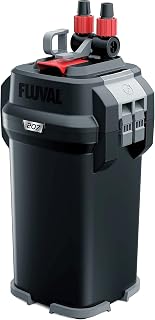
Fluval 207 Performance Canister
The Fluval 307 circulates 303 GPH on an efficient 16W motor head, rated for setups up to 70 gallons. Its vertical pre-filter cartridge captures coarse debris before water reaches the horizontal media baskets. Dual locking clamps and ergonomic lift handles make routine media changes painless.
Published specs
Ideal for: Planted tanks and community aquariums up to 70 gallons where easy, mess-free maintenance is vital. · Skip if: You require smooth vinyl hosing for third-party inline heaters or UV sterilizers.
Strengths: Vertical pre-filter assembly offers superior mechanical surface area; EZ-Lift media baskets feature center handles for fast extraction; Low 16W consumption with whisper-quiet motor operation.
Drawbacks: Ribbed hosing collects internal biofilm and resists standard inline gear; Rated for moderate tank sizes up to 70 gallons.
 7.1/10
Quick decision table
- Large freshwater community tanks, predator setups, and messy cichlid aquariums up to 250 gallons.
- Fluval FX4 High Performance Canister Aquarium (Best Heavy-Duty Performance) — Massive 700 GPH circulation for high-bioload habitats
- Medium to large planted aquariums up to 160 gallons where silent operation and energy savings matter.
- Fluval FX6 High Performance Canister (Best Energy Efficiency) — Ultra-low 16W energy consumption minimizes annual utility cost
- Aquascapers and refined display setups up to 160 gallons seeking minimal hardware inside the tank.
- OASE BioMaster 2 850 Canister (Best Thermal Integration) — Internal heating element keeps display tanks clutter-free
- Cost-conscious hobbyists seeking maximum media volume for large freshwater communities.
- Fluval 407 Performance Canister (Best Budget Capacity) — Five deep media baskets provide unmatched customization for the price
How do you evaluate flow rate, media volume, and power efficiency?
Evaluating the best aquarium canister filters starts with understanding gross pump ratings versus net system circulation. Manufacturers calculate Gallons Per Hour (GPH) using an empty canister running uninhibited water. Once you pack media baskets with foam pads, biological ceramic rings, and chemical resins, real flow drops by 30 to 50 percent.
Media capacity dictates long-term biological stability. Units with large, compartmentalized baskets allow beneficial nitrifying bacteria to thrive across vast porous surface areas. Solid perimeter seals prevent bypass, forcing water through every layer rather than allowing dirty water to slip past loose basket edges into the clean return line.
Motor wattage governs continuous running costs. Modern canister motors run 24 hours a day, making a 16W European magnetic rotor significantly cheaper to operate over five years than an unoptimized 32W motor. Choose equipment engineered with ceramic shafts, precision magnetic impellers, and balanced hydraulic flow paths.
- Target genuine turnover of 4 to 6 times total aquarium volume per hour after media resistance.
- Verify internal basket tolerances to ensure mechanical bypass cannot circumvent biological media.
- Prioritize ceramic impeller shafts over stainless steel for reduced wear and whisper-quiet operation.
- Check hose diameter standards, as 16/22 mm connections offer broad compatibility with inline gear.
Which features define entry-level, midrange, and premium canister tiers?
Budget tiers reflect mechanical build quality, priming convenience, and motor engineering. Entry-level models under $100 offer high gross flow ratings but rely on thinner polymers, rudimentary manual priming plungers, and higher power consumption. They provide functional mechanical and biological filtration for aquarists willing to tolerate occasional operational noise.
Midrange units between $100 and $250 strike the ideal balance between build durability and running costs for value-focused buyers. These models introduce precision Italian or German magnetic drives, lower wattage profiles, robust quick-disconnect valves, and anti-vibration footings. They prevent leaks through heavy-duty silicone gaskets and tight basket tolerances.
Premium units exceeding $250 introduce electronic flow monitoring, automatic air purging, and integrated heating chambers. High-end systems like the Fluval FX series and Oase BioMaster Thermo consolidate equipment, vent trapped microbubbles automatically, and handle high-bioload setups up to 250 gallons without frequent motor clogging.
- Under $100: Basic ABS plastic shells, 20W to 35W power draws, manual siphon priming buttons.
- $100 to $250: Energy-efficient 14W to 22W motors, quick-release shutoff valves, floating trays, quiet impellers.
- Over $250: Microprocessor pump control, integrated thermal elements, independent pre-filter chambers, 700+ GPH capacity.
How do the top aquarium canister filters compare across key specifications?
Direct spec comparisons reveal the sharp performance variations separating leading market options. While maximum tank volume ratings provide a general baseline, matching flow rate against motor wattage reveals genuine engineering quality. High-efficiency models deliver generous hydraulic turnover while keeping thermal output and utility expenses low.
The following aquarium canister filters spec comparison outlines critical performance benchmarks across all ten ranked selections. Comparing these metrics helps you identify whether a model emphasizes raw water movement, biological media volume, or whisper-quiet energy savings for your specific cabinet dimensions.
Take special note of physical dimensions and specialized features. Systems with modular pre-filters or internal heating chambers eliminate auxiliary hardware, providing tangible practical value that extends beyond simple motor horsepower.
| Model Name | Flow Rate (GPH) | Max Aquarium Size | Motor Power | Media Stages | Acoustic Footprint |
|---|---|---|---|---|---|
| Fluval FX4 | 700 GPH | 250 gal | 30W | Multi-Stage Stack | Moderate Low |
| Eheim Pro 4+ 600 | 330 GPH | 160 gal | 16W | 4 Trays | Whisper Quiet |
| Oase BioMaster Thermo 600 | 330 GPH | 160 gal | 22W | 6 Trays + Pre-Filter | Quiet |
| Penn Plax Cascade 1500 | 350 GPH | 200 gal | 32W | 5 Large Trays | Moderate Hum |
| Marineland Magniflow 360 | 360 GPH | 100 gal | 26W | 3 Trays | Standard |
| Sicce Whale 350 | 290 GPH | 90 gal | 14W | 3 Floating Trays | Whisper Quiet |
| Penn Plax Cascade 1000 | 265 GPH | 100 gal | 23W | 3 Trays | Moderate Hum |
| Sicce Whale 500 | 390 GPH | 130 gal | 18W | 4 Floating Trays | Whisper Quiet |
| Marineland Magniflow 220 | 220 GPH | 55 gal | 19W | 2 Trays | Standard |
| Fluval 307 | 303 GPH | 70 gal | 16W | Vertical + 3 Trays | Quiet |
Which critical installation and sizing mistakes cause canister filter failure?
The most widespread purchasing error is choosing a filter based strictly on the manufacturer tank volume rating. Brand ratings assume sparse stocking, miniature fish, and bare aquariums. If you keep heavy-waste species like African cichlids or goldfish, select a filter rated for at least double your actual aquarium volume.
Neglecting head height calculation severely cripples filtration efficiency. Canister pumps push water upward against gravity from inside an aquarium cabinet. When vertical lift exceeds four feet, backpressure cuts pump turnover significantly, starving biological bacteria of dissolved oxygen if your baseline flow was undersized.
Overpacking mechanical media creates another costly operational failure. Stuffing dense polishing wool ahead of biological media blocks water channels and creates negative pressure inside the canister body. This vacuum pulls air past head gaskets, generating irritating microbubbles, noisy impeller chatter, and premature motor burnout.
- Never use manufacturer gallon ratings literally: buy for turnover rate and bioload realities.
- Avoid running ribbed hoses through tight cabinet bends where kinks restrict flow and strain impellers.
- Do not grease canister head gaskets with petroleum jelly, which degrades rubber: use pure silicone lubricant.
- Never wash beneficial biological media in chlorinated tap water during maintenance routines.
How do Fluval, Eheim, Oase, Sicce, and Penn Plax compare on long-term value?
Each leading manufacturer presents distinct engineering philosophies. Fluval excels in hydraulic power, user ergonomics, and electronic self-purging motors, though proprietary ribbed hosing complicates connecting third-party inline equipment. Their 07 series and FX canisters remain benchmark choices for high-flow community and predator habitats.
Eheim and Sicce prioritize acoustic silence, exceptional energy efficiency, and durable ceramic drives. Eheim Pro 4+ models leverage the Xtender flow bypass to avert biological crashes, while Sicce Whale canisters offer outstanding flow-to-wattage ratios. Both brands cost slightly more upfront but deliver remarkable motor longevity.
Oase commands a premium for convenience, integrating heaters and modular pre-filters that pull out without breaking canister siphon seals. Conversely, Penn Plax and Marineland dominate the budget spectrum. They offer voluminous media trays and affordable entry costs, trading away refined acoustic dampening and low electricity consumption.
- Fluval: Maximum flow velocity, ergonomic maintenance clamps, proprietary hosing connections.
- Eheim: Heritage German reliability, ultra-low power consumption, premium precision impellers.
- Oase: Integrated thermal management, separate pre-filter cartridges, premium desktop aesthetics.
- Sicce: Compact Italian engineering, quiet magnetic rotors, superior flow per watt.
- Penn Plax: Maximum basket capacity per dollar, generic parts, louder operating decibels.
Honorable mentions
Close contenders evaluated by Aquariumguide:
Oase BioMaster Thermo 350 Canister
Provides integrated heating and a pre-filter module, but its 290 GPH flow rate offers less headroom for medium aquariums than competing units.
Eheim Classic 350 Canister
Features legendary mechanical simplicity and reliability, but lacks modular media baskets and modern push-button priming valves.
Related Variants & Comparable Alternatives (24)
Additional catalog models in the same series or price tier not duplicated in the shortlist above:
Page updates (2026-11-29)
- 2026-11-29: Audited 12 candidate listings and updated rubric balance on Aquariumguide.
Documented specs
- Fluval Aquatics Technical Manuals (Fluval)
- EHEIM Filter Specification Library (EHEIM)
- OASE Indoor Aquatics Manuals (OASE)